
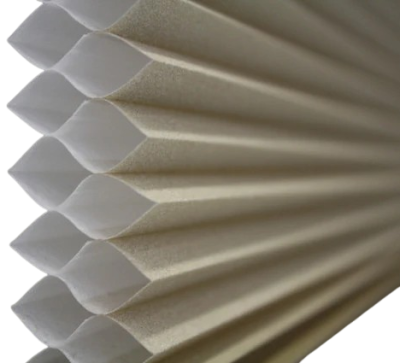
There's a reason honeycomb blinds tend to appear in conversations about both design and energy savings, they genuinely do both jobs well. Unlike most window coverings where it's one or the other, honeycomb blinds are quietly functional in a way that becomes noticeable on your electricity bill over time.
If you've come across them and aren't quite sure what makes them different, this article breaks it down clearly: what they actually do, how pricing works in South Africa, what colours and configurations are available, and whether they're the right choice for your space.
How Honeycomb Blinds Actually Work
The name gives it away. The fabric is constructed with a series of hexagonal cells, the same geometry that makes a beehive structurally efficient, that trap a layer of air when the blind is lowered.
That air layer acts as a thermal buffer between the cold or hot glass surface and the room interior. In summer, it slows the transfer of heat from the window into the room. In winter, it reduces the amount of warmth that escapes through the glass.
Single-cell structures provide a meaningful improvement over standard roller or venetian blinds. Double-cell configurations add a second layer of trapped air and improve insulation further, making them particularly worthwhile on larger windows or rooms that struggle to maintain a stable temperature.
This is explained in more detail in the energy-efficient honeycomb blinds guide, which covers how the cell structure compares to other blind types.
Single-Cell vs Double-Cell: Which Should You Choose?
Single-cell honeycomb blinds
Single-cell blinds have one layer of honeycomb cells. They provide solid light diffusion and moderate insulation, and are a practical upgrade over most standard blind types. They're the more common choice for rooms where temperature control matters but isn't the primary concern.
Double-cell honeycomb blinds
Double-cell blinds stack two layers of honeycomb cells, creating a thicker air barrier. The insulation improvement over single-cell is noticeable, and they're particularly effective on north-facing windows in summer or in rooms that lose heat quickly in winter.
If energy efficiency is the main reason you're considering honeycomb blinds, double-cell is worth the additional cost.
Honeycomb Blind Colours and Fabrics Available in South Africa
Light-filtering vs blackout honeycomb fabric
Honeycomb blinds are available in both light-filtering and blackout fabrics. Light-filtering honeycomb fabric softens natural light while maintaining the cell structure's insulating properties, the light passes through but is diffused gently, making them ideal for living areas and home offices.
Blackout honeycomb blinds use a coated fabric cell that blocks light entirely. These are the better choice for bedrooms, nurseries, or media rooms where light control is as important as insulation.
Colour options
The majority of honeycomb blinds are produced in neutral tones — whites, off-whites, creams, light greys, and sand tones. This isn't a limitation; it reflects how they perform best. The lighter the fabric, the more light the blind reflects back rather than absorbing, which supports both the insulating function and the light-diffusion quality.
That said, darker colours are available for spaces where a more moody or dramatic finish is preferred.
Browse the full honeycomb blind range to explore current colour options.
Honeycomb Blinds Prices in South Africa
Honeycomb blinds are generally priced higher than standard roller or aluminium venetian blinds, which reflects the fabric's complexity and the functional benefit it provides. The price per blind is influenced by:
- Window size — wider and taller windows require more material
- Single vs double-cell fabric — double-cell costs more but delivers stronger insulation
- Blackout vs light-filtering — blackout fabric typically sits at a slightly higher price point
- Custom sizing — honeycomb blinds are almost always made to measure
For buyers in Johannesburg, Pretoria, or Cape Town considering honeycomb blinds for multiple rooms, it's worth treating this as an investment rather than a commodity purchase. The energy savings over time are real, particularly in rooms with large or west-facing windows.
Which Rooms Benefit Most from Honeycomb Blinds?
Bedrooms — blackout honeycomb blinds combine sleep-friendly darkness with temperature regulation, which is a practical pairing.
Living rooms with large windows — a single wide window can significantly affect a room's temperature. A double-cell light-filtering honeycomb blind makes a meaningful difference on exposed north or west-facing glazing.
Home offices — light-filtering honeycomb fabric reduces screen glare and keeps working temperatures more stable without blocking natural light entirely.
Children's rooms — the blackout option serves obvious benefits, and the low-maintenance fabric is a practical advantage.
Common Misconceptions About Honeycomb Blinds
"They only work in cold climates." South Africa's summer heat is exactly the environment where honeycomb blinds perform well. Reducing solar heat gain through windows during summer is just as valuable as reducing heat loss in winter.
"They're hard to clean." The fabric cells are delicate compared to aluminium or PVC blinds, but they don't require frequent cleaning. Light dusting with a soft brush or low-suction vacuum is sufficient for regular maintenance.
"Light-filtering means poor privacy." Light-filtering honeycomb fabric allows light through while maintaining privacy during daylight hours. At night, with interior lights on, privacy is reduced — a consideration worth planning for.
FAQ
What is the difference between honeycomb and cellular blinds? They are the same product. "Honeycomb" refers to the hexagonal cell shape of the fabric structure; "cellular" is the general industry term. Both describe the same type of blind.
Are honeycomb blinds available in custom sizes in South Africa? Yes. Honeycomb blinds are made to measure as standard. The cell structure requires accurate fabric cutting to maintain the integrity of the insulating cells at the edges.
Do honeycomb blinds work without a window seal? They improve insulation in any window, but their performance is best when the blind fits close to the glass with minimal gap at the sides. Inside-mount fitting within the window recess delivers the best thermal result.
Can I get free fabric samples before ordering? Yes — request free fabric samples through the Blinds Online website before committing to a colour or fabric type.
A Practical Investment, Not Just a Window Covering
Honeycomb blinds are one of those purchases that pays for itself differently to most home improvements — gradually, through more stable indoor temperatures and reduced reliance on heating and cooling. If you're in Johannesburg, Pretoria, Cape Town, or anywhere in between, the climate case for them is strong year-round.
Explore the honeycomb blind range.